•  
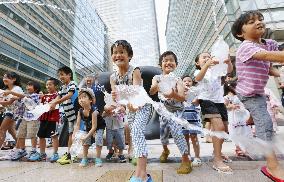
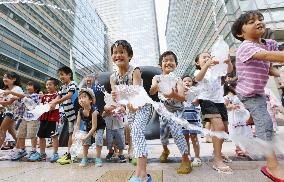
Cooling streets with water on hot summer day

Cooling streets with water on hot summer day

TOKYO, Japan - Children sprinkle a street with water in Tokyo on July 23, 2014, marking "Taisho," a lunar calendar term showing the hottest period of the year.

  •  
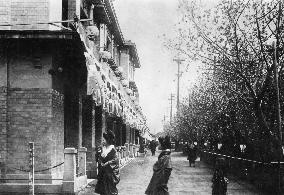
Yoshiwara red-light district

Yoshiwara red-light district

TOKYO, Japan - The file photo shows Yoshiwara, Japan's largest licensed red-light district until prostitution was banned in 1957, located in Tokyo. The Taisho-period (1912-1926) photo was taken before the Great Kanto Earthquake struck areas in and around Tokyo in 1923.

  •  
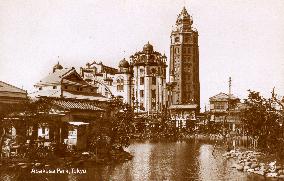
Japan - Asakusa Luna Park, Tokyo

Japan - Asakusa Luna Park, Tokyo

Japan - Asakusa Luna Park, Tokyo - the park was designed to mimic the original Luna Park that was built in Brooklyn, New York in 1903. Date: circa 1920

  •  
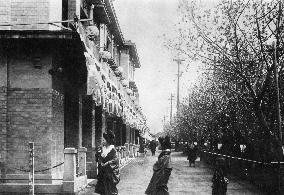
Yoshiwara red-light district

Yoshiwara red-light district

TOKYO, Japan - The file photo shows Yoshiwara, Japan's largest licensed red-light district until prostitution was banned in 1957, located in Tokyo. The Taisho-period (1912-1926) photo was taken before the Great Kanto Earthquake struck areas in and around Tokyo in 1923. (Kyodo)

  •  
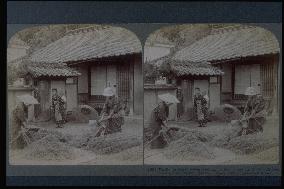
A scene of threshing

A scene of threshing

This is one of many stereographs taken during the Taisho Period (1912-1925). It is entitled Thrifty Farmers' Wives Hulling Barley by Pulling It Through Combs. It is a typical scene of a Japanese farming village in the Taisho Period.==Date:1904, Place:Iwakuni, Photo:Underwood, (Credit:Nagasaki University Library/Kyodo News Images) [Cabinet Number97‐8‐0]

  •  
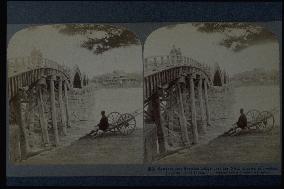
Kintai-kyo Bridge

Kintai-kyo Bridge

This is one of many stereographs taken during the Taisho Period (1912-1925). This photograph shows a side view of the famous Kintai Bridge from downstream. The photograph is entitled The Extraordinary Five-Arch Bridge over Nishiki River in Iwakuni.==Date:1904, Place:Iwakuni, Photo:Underwood, (Credit:Nagasaki University Library/Kyodo News Images) [Cabinet Number97‐7‐0]

  •  
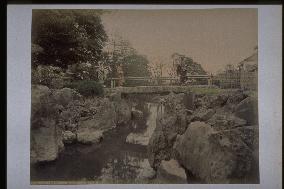
Satake Garden,Mukojima

Satake Garden,Mukojima

Called Koyoen, the garden of the Akita Clan Satake family opened to the public in the mid-Meiji Period and gained fame as one of the most beautiful gardens of the former Edo. However, in 1903 it became the possession of Sapporo Brewery Company, which established its Azuma-bashi factory nearby and used the remainder of the garden as a beer garden where customers could enjoy the product of the brewery. In 1906, the facility became the Dai Nippon Brewery Company Azuma Factory, and the garden disappeared in the wake of factory expansions during the Taisho Period (1912-1926) and the Great Kanto Earthquake of 1923. Today, a few trees and an explanation panel next to the Sumida Ward Hall are the only reminders of the former garden.==Date:unknown, Place:Tokyo, Photo:unknown, (Credit:Nagasaki University Library/Kyodo News Images) [Cabinet Number85‐9‐0]

  •  
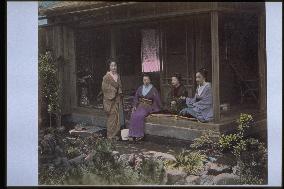
Women relaxing on a veranda

Women relaxing on a veranda

Four geisha are relaxing on the engawa porch of a guest room with windows, looking at the garden. The woman on the left has her hair arranged in marumage style with floral hairpins and her striped sash tied in chidori-musubi fashion. She is holding a shamisen lute. The slightly elderly woman next to her is wearing black lacquer clogs with high supports. Next to her is an apprentice geisha, and the woman on the far right wears a brightly coloured kimono. A reed chair is visible on the right. Taken in the late Meiji or Taisho Period.==Date:unknown, Place:unknown, Photo:R. Stillfried, (Credit:Nagasaki University Library/Kyodo News Images) [Cabinet Number77‐49‐0]

  •  
Students

Students

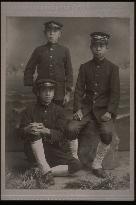
A group shot of students, this was reportedly taken in Sasebo, Nagasaki Prefecture, in the Taisho Period (1912-1925).==Date:unknown, Place:Sasebo, Photo:unknown, (Credit:Nagasaki University Library/Kyodo News Images) [Cabinet Number72‐62‐0]

  •  
Children and their teacher on a school excursion

Children and their teacher on a school excursion

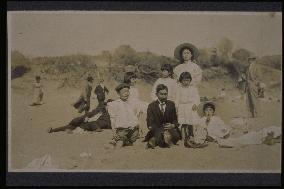
This may be a scene of families participating in a company excursion. A few of the men and women are dressed in formal attire. Perhaps this is a scenes of teachers and pupils on an outing. The details are unknown. Taken in the late Meiji or Taisho Period.==Date:unknown, Place:unknown, Photo:unknown, (Credit:Nagasaki University Library/Kyodo News Images) [Cabinet Number72‐65‐0]

  •  
A private house and men,Nagasaki

A private house and men,Nagasaki

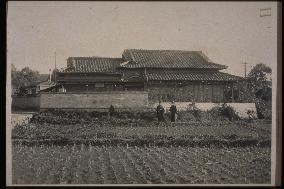
Two men are standing in front of a large house in a suburb with rice paddies and vegetable fields. This is a modern building with a long brick fence. The large rooftop of an iriomoya main wing is visible. The electric poles already installed at many locations indicate that it is the Taisho Period.==Date:unknown, Place:Nagasaki, Photo:unknown, (Credit:Nagasaki University Library/Kyodo News Images) [Cabinet Number72‐28‐0]

  •  
Inokashira Benten

Inokashira Benten

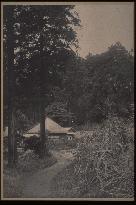
The back of the photograph carried the inscription, Taken at Benten, Inokashira, Tokyo in September 1913. This must be Inokashira, the origin of one of Edo's water supplies. Many trees were planted around Inokashira Pond to preserve the water resources. Inokashira Benzaiten (one of the seven deities of luck) is on a small island called Nakanoshima in the western part of the pond. A Taisho-Period postcard shows Benzaiten with a beautiful thatched roof by a pond. The lack of a pond in this photograph and the simple structure of the house suggest that this is not Benzaiten but a teahouse nearby.==Date:1913, Place:Tokyo, Photo:unknown, (Credit:Nagasaki University Library/Kyodo News Images) [Cabinet Number72‐23‐0]

  •  
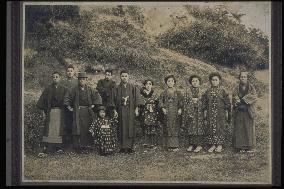
Ueno Saneo and his friends

Ueno Saneo and his friends

Little is know today about Ueno Saneo. The people in the photograph are probably his family, servants, and friends. They all wear Japanese kimono, and the hairstyles of the women indicate the Taisho Period.==Date:1920, Place:Awajishima, Photo:unknown, (Credit:Nagasaki University Library/Kyodo News Images) [Cabinet Number72‐9‐0]

  •  
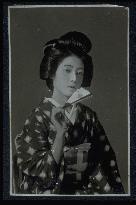
A woman holding a folding fan

A woman holding a folding fan

The photograph was taken after the mid-Meiji Period, perhaps as late as the Taisho or early Showa Period. The woman's posture suggests that she is posing for a portrait to be used as an advertisement for a geiko (female entertainer).==Date:unknown, Place:unknown, Photo:unknown, (Credit:Nagasaki University Library/Kyodo News Images) [Cabinet Number71‐67‐0]

  •  
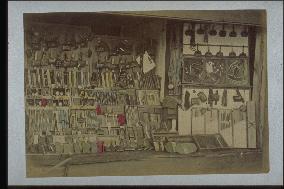
A pipe shop

A pipe shop

The kiseru is a Japanese-style tobacco pipe, but the etymology goes back to the word khsier which means tube in Cambodian. It has three parts, the bowl where the tobacco is placed, the tube for smoke, and the mouth piece. The shop in the photo has all sorts of smoking tools including kiseru. In the Taisho period, the demand for paper wrapped tobacco increased, and the kiseru has become almost extinct.==Date:Middle Meiji, Place:unknown, Photo:unknown, (Credit:Nagasaki University Library/Kyodo News Images) [Cabinet Number13‐15‐0]

  •  
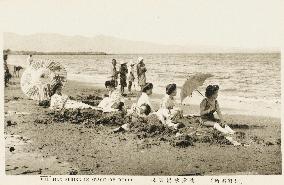
Beppu Hot Springs, Japan - the seashore

Beppu Hot Springs, Japan - the seashore

Beppu, Japan. The city was founded on April 1, 1924, and is famous for its onsen (hot springs), which are regarded as sacred. Beppu is Japan's onsen capital with the largest volume of hot water in the world apart from Yellowstone in the United States and the largest number of hot spring sources in Japan. Beppu contains nine major geothermal hot spots, which are sometimes referred to as the nine hells of Beppu. This souvenir card depicts local people enjoying the properties of the sand and the sea air of the beach at Beppu. Date: circa 1930

  •  
Cooling streets with water on hot summer day

Cooling streets with water on hot summer day

TOKYO, Japan - Children sprinkle a street with water in Tokyo on July 23, 2014, marking "Taisho," a lunar calendar term showing the hottest period of the year. (Kyodo)

  •  
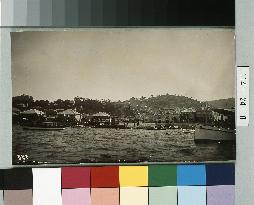
Matsugae Viewed from Ocean

Matsugae Viewed from Ocean

This is a view of the Western-style buildings along the Oura waterfront. The German Consulate is seen to the left of Matsugae Bridge. The house at No.12 Higashiyamate is visible in the back, with the two-story building of Kaisei School (built in 1898) at the summit. This scenery is from the early Taisho Period (ca.1912).==Date:unknown, Place:Nagasaki, Photo:unknown, (Credit:Nagasaki University Library/Kyodo News Images) [Cabinet Number114‐24‐0]

  • Main
  • Top
  • Editorial
  • Creative
  • About Us
  • About ILG
  • Terms of use
  • Company
  • BEHIND
  • Price List
  • Single Plan
  • Monthly Plan
  • Services
  • Shooting
  • Rights Clearance
  • Support
  • FAQ
  • How To Buy
  • Contact Us
  • Become a Partner

© KYODO NEWS IMAGES INC

All Rights Reserved.

  • Editorial
  • Olympics
  • News
  • Sports
  • Japan
  • Tech
  • Royal
  • Disaster
  • NorthKorea
  • Old Japan
  • SNS
  • Creative
  • Food
  • Japan
  • Landscape
  • Animal
  • Popular
  • #Ukraine
  • #China
  • #coronavirus
  • #N. Korea
  • #Russia
  • #Thailand
  • #Ukraine
  • #China
  • #coronavirus
  • #N. Korea
  • #Russia
  • #Thailand
  • Food
  • Japan
  • Landscape
  • Animal
  • Olympics
  • News
  • Sports
  • Japan
  • Tech
  • Royal
  • Disaster
  • NorthKorea
  • Old Japan
  • SNS